From Penny-Farthing to Safety Bicycle: How the Frame Changed
Penny-farthing to safety bicycle: learn how wheel size, rider position and drive layout changed the machine’s balance, steering and everyday handling.
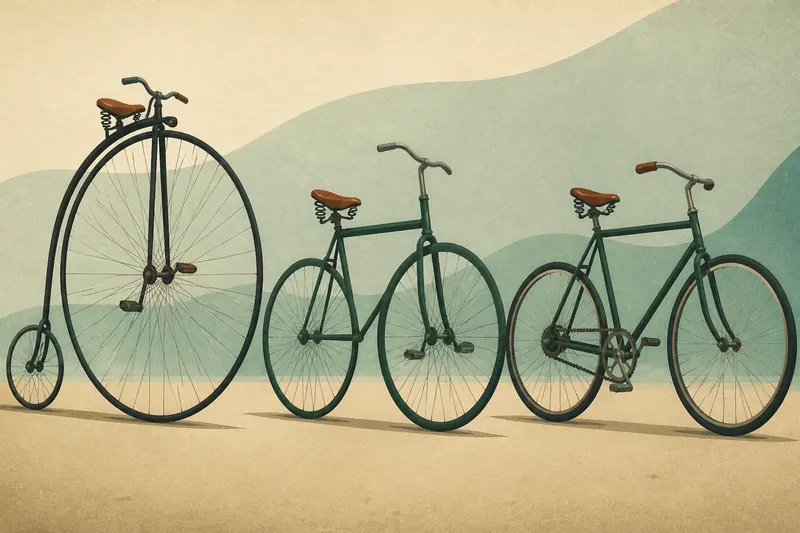
Why did the bicycle shift from a giant front wheel to two wheels of similar size? The penny-farthing to safety bicycle change involved more than appearance: it altered where the rider sat, which wheel steered, and how pedal power reached the road.
Geometry means the arrangement and proportions of a machine’s parts. Comparing a high-wheeler, an early direct-drive safety bicycle and a chain-driven safety bicycle makes the design choices easier to see without treating the change as a single, precisely dated invention.
The high wheel
The penny-farthing, or high-wheeler, placed a very large front wheel beneath the rider and a much smaller wheel behind. Its pedals turned the front wheel directly, so each crank rotation made that wheel turn once. A larger wheel covered more ground per rotation, without a chain or separate gears.
The front wheel both steered and drove the bicycle. Because its hub and pedals were high above the ground, the rider sat high too, and mounting required climbing onto the machine. Starting, stopping or dealing with an unexpected obstacle could therefore demand more careful control than on a lower bicycle.
These are consequences of the layout, not a complete account of why every rider or maker chose it. The large front wheel provided a direct way to travel farther per pedal turn, while the high position and mounting method were evident trade-offs.
Lower safety designs
Safety bicycle is a broad name for lower designs that moved away from the high-wheeler’s extreme front wheel. Their details differed: some kept direct drive, with pedals turning the front wheel, while other designs tried different ways of transmitting power. It is more accurate to describe a family of experiments than one uniform machine.
A smaller front wheel made a lower riding position possible, but a direct-drive layout still joined steering and propulsion at the same wheel. When the rider turned the handlebar, the driven wheel changed direction too. Lowering the saddle addressed the high-wheeler’s elevation, but did not by itself separate the two jobs.
Chain drive offered a different arrangement. A chain could link the pedals to a sprocket at the rear wheel, leaving the front wheel to steer. This separated the drive from the steering without requiring the front wheel to be the oversized part of the machine.
Chain-driven geometry
In the familiar chain-driven layout, the rider sits between wheels of broadly similar size. The pedals turn a crankset, and a chain carries that rotation to a sprocket at the rear hub. The front wheel steers; the rear wheel drives.
Because the crankset and rear wheel no longer had to share a hub, designers could arrange them separately. That made it possible to consider saddle height, wheelbase—the distance between the wheel axles—and the rider’s reach to the handlebars without making a huge front wheel the defining feature.
The chain works rather like a belt connecting two separate pulleys: the parts it links need not sit on one shaft. On a bicycle, that arrangement gives the pedals and driving wheel distinct positions, while the chain and sprocket sizes determine how their rotation relates.
What geometry changes
The three layouts ask different things of the rider. A high-wheeler offers direct drive through the front wheel but places the rider high. A direct-drive safety design lowers the position while retaining steering and propulsion at the front. A chain-driven safety bicycle puts the rider between the wheels and sends pedal power to the rear.
None of these descriptions means that one frame feels the same for every rider or route. Wheelbase, handlebar position, frame proportions and posture all affect how a particular bicycle handles. Nor should the broad design shift be read as a simple story in which one shape immediately replaced every other.
Say a rider needs to use a narrow lane with gates and frequent stops. Starting with the high-wheeler’s tall saddle and mounting method, the rider would have to manage repeated mounting and dismounting; choosing a lower safety design would make that part of the task more manageable. If the rider also wants steering independent of pedal pressure, a chain-driven layout fits that design preference. This invented situation illustrates the trade-offs, not a claim that one bicycle suits every person.
Questions about the shift?
Why was the penny-farthing’s front wheel so large?
Its pedals drove the front wheel directly, and a larger wheel travelled farther per crank turn. The trade-off was a high riding position, with steering and drive concentrated at the same wheel.
Did every early safety bicycle use a chain?
No. Some lower designs retained direct drive, while others explored different arrangements. The term refers to a range of layouts, not a single standard machine.
What changed with chain drive?
The chain linked the pedals to the rear wheel, leaving the front wheel to steer. It also allowed the pedals and driving wheel to occupy separate positions.
How can I read an unfamiliar bicycle frame?
Check where the rider sits, which wheel receives pedal power, and which wheel turns with the handlebars. Those observations reveal the central design differences more clearly than appearance alone.
Reading the frame
Trace the rider’s position from saddle to pedals, then follow the drive to the wheel. On a high-wheeler, the saddle sits above the front hub and the pedals turn that hub directly. On a chain-driven safety bicycle, the rider sits between the wheels and the chain carries power rearwards.
The penny-farthing to safety bicycle shift is easiest to understand as a change in the relationship between rider, steering and propulsion, rather than as a simple contest in which one design was best. When you look at a historical bicycle or replica, identify where the rider’s weight rests, which wheel the pedals drive and what the handlebars control; those details make its geometry legible.