Why Bicycle Gears Are Paired in Steps
Bicycle gear ratios explain why each chainring and sprocket pairing changes pedalling effort in a gradual, useful way rather than by magic.
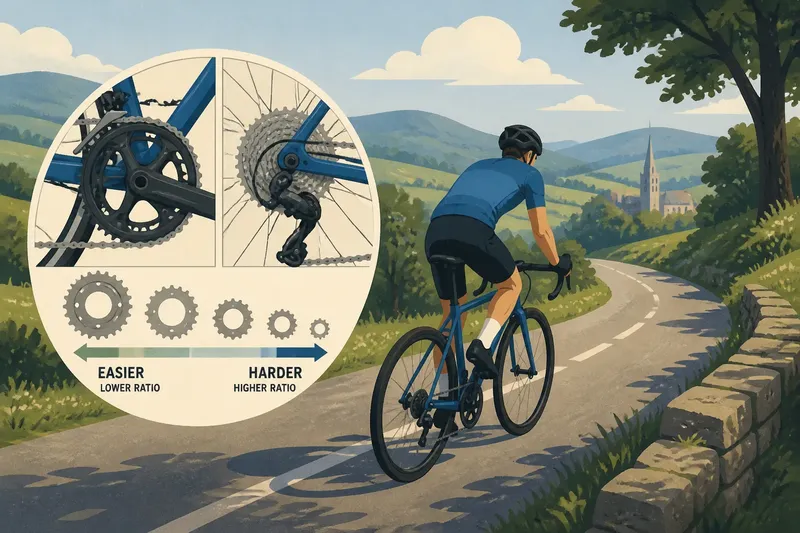
Why does one shift make your pedals feel heavier while the next seems only a small change? Bicycle gear ratios answer that question: each choice pairs a front chainring with a rear sprocket, and their relative sizes set how far the bike moves for each turn of the pedals. Once you can read that pairing, the sequence of gears becomes a set of understandable options.
Start with the two parts
The chainring is the toothed wheel attached to the pedals. The sprockets sit on the rear wheel’s cassette or freewheel. When you pedal, the chain carries movement from the chainring to one rear sprocket, which turns the back wheel.
Count the teeth to compare their sizes. A chainring with more teeth pulls more chain during one pedal revolution. A rear sprocket with more teeth turns fewer times as that chain passes over it. The pairing, not either component alone, determines the gear ratio.
Read a gear ratio
To calculate a basic ratio, divide the chainring’s tooth count by the selected sprocket’s tooth count. For instance, a chainring with 36 teeth paired with a sprocket with 18 teeth gives a ratio of 2:1. In ideal conditions, one full turn of the pedals turns the rear wheel about twice.
Change to a 24-tooth sprocket while keeping that same chainring, and the ratio becomes 1.5:1. The wheel turns fewer times per pedal revolution, so the pedals are easier to push but the bike travels less distance for each turn. This is a lower gear. The 18-tooth pairing is higher: it takes more force at the pedals, while each turn drives the wheel farther.
Think of the rear sprockets as the different-sized gears inside a hand-cranked tool. A larger driven gear turns more slowly for the same input, giving you a less demanding action; a smaller one turns faster. The bicycle’s chain makes the relationship visible, but the arithmetic is the same kind of comparison.
Compare neighbouring choices
Lay out the rear sprocket sizes from largest to smallest. With a given chainring, the largest sprocket makes the lowest gear and the smallest makes the highest. On a cassette marked with tooth counts, you can compare adjacent values and see whether each shift is a small or a larger change.
Now compare chainrings. A smaller chainring paired with the same rear sprocket gives a lower ratio; a larger one gives a higher ratio. On a bike with more than one chainring, each front-ring choice overlaps part of the rear cassette’s range. This overlap creates alternative pairings with similar ratios, rather than a mysterious collection of unrelated gears.
Say you are approaching a gentle rise in a town park in a middle gear. You notice your pedalling becoming strained, so you shift to a larger rear sprocket while keeping the same chainring. The ratio falls, and the pedals should feel easier to turn; once the path levels, shifting back to a smaller sprocket restores a firmer, higher gear.
Why gears form steps
A cassette offers a limited set of sprockets, not every possible tooth count. The difference between one sprocket and its neighbour creates a distinct ratio change. Where neighbouring sizes are close, the shift tends to feel more subtle; where they are farther apart, the change is more noticeable.
That is why gears feel graduated. Each pairing represents a practical choice between pedal force and distance travelled per revolution. The sequence can help you adjust effort as the ground changes, but it cannot keep effort identical on every surface: slope, speed, wind and the bike’s load all affect how a gear feels.
Gear names such as “low” and “high” describe the ratio, not the number printed on a shifter. A lower ratio is useful when you want the pedals to turn more easily, while a higher ratio suits situations where you can push a firmer turn. The gear number alone may be ambiguous because controls label their positions differently.
Choose a pairing in motion
Begin with the gear you are using and notice the sensation at the pedals. If they feel stubborn as the road tilts upwards, choose an easier ratio by shifting the rear derailleur towards a larger sprocket. If your legs are turning freely but the pedals feel too light for the ground, try a smaller rear sprocket for a higher ratio.
On a multi-chainring bike, changing the front chainring makes a larger change than many shifts at the rear. A smaller front ring lowers the ratio; a larger one raises it. Rear shifts are often useful for fine adjustments, while a front shift can move you into another band of ratios. Avoid combining the smallest front ring with the smallest rear sprocket, or the largest front ring with the largest rear sprocket, if the chain then runs at a pronounced diagonal; that position can add noise and wear.
Make a shift while you are pedalling smoothly, easing pressure briefly as the chain moves. If a gear change is noisy or fails to settle, do not force the shifter; a bicycle mechanic can check adjustment and wear. For the exact range and operating advice for your bicycle, follow the component maker’s instructions, and check any local rules that apply to equipment.
Questions about ratios?
What is a bicycle gear ratio?
It is the chainring’s tooth count divided by the selected rear sprocket’s tooth count. The result describes how many rear-wheel turns correspond approximately to one pedal revolution, before accounting for the wheel itself.
Does a bigger rear sprocket make pedalling easier?
Yes, relative to the same chainring, a bigger rear sprocket lowers the ratio. The wheel turns less for each pedal turn, so the pedals require less force for a given riding situation.
Why do two different gears sometimes feel alike?
Different chainring-and-sprocket pairings can produce similar ratios. Their tooth counts differ, but the relationship between the two can be close enough for the change in pedalling feel to be subtle.
Which gear should I use on a hill?
Use a lower ratio if the pedals feel difficult to turn: shift towards a larger rear sprocket, or a smaller front chainring if your bike has one. Choose according to the slope and your comfort, then adjust as the ground changes.
When a gear feels unexpectedly hard or easy, look at the pairing rather than treating the shifter position as a secret code. Bicycle gear ratios connect visible tooth counts to a practical choice: how much force each pedal turn asks of you, and how far that turn carries the bike.